Colon Cancer Background

“Hey guys, here’s some background on Colon Cancer. Be sure to get a colonoscopy if you are concerned, or over the age of 50. I got you.”
— Dr. Dale

Invasive colorectal cancer is a preventable disease. Early detection through widely applied screening programs is the most important factor in the recent decline of colorectal cancer in developed countries (see Deterrence/Prevention).

Full implementation of screening guidelines[4] could cut mortality rate from colorectal cancer in the United States by an estimated additional 50%; even greater reductions are estimated for countries where screening tests may not be widely available at present. New and more comprehensive screening strategies are also needed.

Fundamental advances in understanding the biology and genetics of colorectal cancer are taking place. This knowledge is slowly making its way into the clinic and being employed to better stratify individual risks of developing colorectal cancer, discover better screening methodologies, allow for better prognostication, and improve the ability to predict benefit from new anticancer therapies.

In the past 10 years, an unprecedented advance in systemic therapy for colorectal cancer has dramatically improved outcome for patients with metastatic disease. Until the mid-1990s, the only approved agent for colorectal cancer was 5-fluorouracil. Since then, new agents in a variety of classes have become available, including the following:

  • Cytotoxic agents (eg, irinotecan, oxaliplatin) [5] 

  • Oral fluoropyrimidines (ie, capecitabine and tegafur) 

  • Biologic agents (eg, bevacizumab, cetuximab, panitumumab) [6] 

  • Most recently, anti-angiogenic agents (ie, ziv-aflibercept, regorafenib) 

Although surgery remains the definitive treatment modality, these new agents will likely translate into improved cure rates for patients with early-stage disease (stage II and III) and prolonged survival for those with stage IV disease. Further advances are likely to come from the development of new targeted agents and from better integration of systemic therapy with other modalities such as surgery, radiation therapy, and liver-directed therapies.

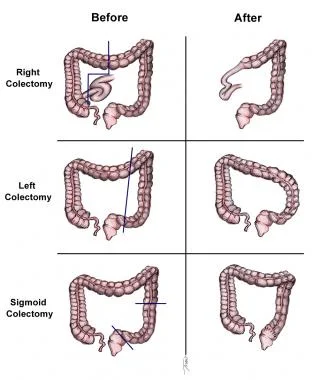
An image depicting standard colectomies for adenocarcinoma of the colon can be seen below.

Source: http://emedicine.medscape.com/article/277496-overview#a3


Vitamin C Kills Colorectal Cancer Cells

http://www.medicaldaily.com/high-dose-vitamin-c-kills-mutant-colorectal-cancer-cells-suggesting-new-treatment-360682

By Lecia Bushak

Vitamin C, which is found in foods like oranges, bell peppers, broccoli, and papayas, has a variety of health benefits — from immune system protection to preventing against cardiovascular, eye disease, and skin wrinkles. Now, new research suggests that Vitamin C may also aid in the fight against cancer, particularly colorectal cancer.

The study, published in Science, focused primarily on colorectal cancer cells that had particularly mutations in KRAS and BRAF genes, which are involved in cell growth. When these mutated cells were exposed to high plasma levels of vitamin C, the researchers found that the cells take in the oxidized form of vitamin C through a certain receptor that happens to be over-expressed in mutated cells. As a result, the cancer cells undergo oxidative stress, turning off the enzyme necessary for the mutated cells to reproduce.

In the study, the researchers tested this out in mice; the vitamin C proved to destroy the mutated cancer cells. They note that Vitamin C could be useful because regular cancer therapies aren’t able to target the mutated cells.

“More than half of human colorectal cancers carry either KRAS or BRAF mutations, and are often refractory to approved targeted therapies,” the authors write in the abstract. “We report that cultured colorectal cancer cells harboring KRAS or BRAF mutations are selectively killed when exposed to high levels of vitamin C.”

It’s important to point out here, however, that it’s highly improbable the findings can actually be put to use. The notion that vitamin C can somehow stop cancer is highly contentious in the scientific world. Past research has examined the effect of vitamin C in cancer treatment since the 1970s, and the results are often contradictory. According to the National Cancer Institute, during cancer treatments, vitamin C is most effective if it’s administered via intravenous (IV) infusion, through a vein directly into the bloodstream. Some studies have shown that high doses of vitamin C may reverse the growth of prostate, pancreatic, liver, colon, and other kinds of cancer cells, but not many of these studies were later found to be flawed, according to the Mayo Clinic. However, some other researchers still believe that vitamin C therapy may be helpful in combination with other standard cancer treatments like chemotherapy or radiation.

Source: Yun J, Mullarky E, Lu C, Bosch K, Kavalier A, Rivera K. Vitamin C selectively kills KRAS and BRAF mutant colorectal cancer cells by targeting GAPDH. Science, 2015.

Cancers caught during screening colonoscopy are more survivable

“Please talk to me about getting checked before you show symptoms. ”
— Dr. Dale

http://www.sciencedaily.com/releases/2015/07/150713143655.htm

Patients whose colorectal cancer (CRC) is detected during a screening colonoscopy are likely to survive longer than those who wait until they have symptoms before having the test, according to a study in the July issue of GIE: Gastrointestinal Endoscopy, the monthly peer-reviewed scientific journal of the American Society for Gastrointestinal Endoscopy (ASGE).

The study, "Survival in patients with colorectal cancer diagnosed by screening colonoscopy," looked at 312 patients in 10 gastroenterology practices in Germany, all aged 55 or older, who were diagnosed with CRC in 2003-2005. Of those, 60 patients were diagnosed during a screening colonoscopy, meaning they had no symptoms and/or only a negative fecal occult blood test (FOBT). The other 252 patients had their cancers detected during a diagnostic colonoscopy, following a positive FOBT and/or symptoms including abdominal pain, iron deficiency anemia, weight loss, changes in bowel habits, or rectal bleeding.

None of the patients had had a previous colonoscopy, and all received endoscopic follow-up care. The patients were followed for as long as 10 years after diagnosis.

Patients whose cancer was detected during screening colonoscopy lived 20.2 months longer, on average, than those who had the test after noticing symptoms or having a positive FOBT (diagnostic colonoscopy). The latter group tended to have more advanced stage tumors; as expected, those whose cancer was in a more advanced stage had shorter survival times.

About 55 percent of the patients with diagnostic colonoscopy, and about 77 percent of the screening colonoscopy patients, survived beyond the time period of the study.

According to the lead author, Kilian Friedrich, MD, "We know that screening colonoscopy can prevent cancer by detecting and removing precancerous polyps. Independent of that, this study shows that screening colonoscopy also can contribute to reduced mortality from colorectal cancer by catching tumors at earlier and more treatable stages."

The researchers concluded that, although screening approaches differ between nations, this finding of increased survival among recipients of screening colonoscopy likely applies to other countries.

Story Source:

The above post is reprinted from materials provided by American Society for Gastrointestinal Endoscopy. Note: Materials may be edited for content and length.