HEALOW App - Now Available

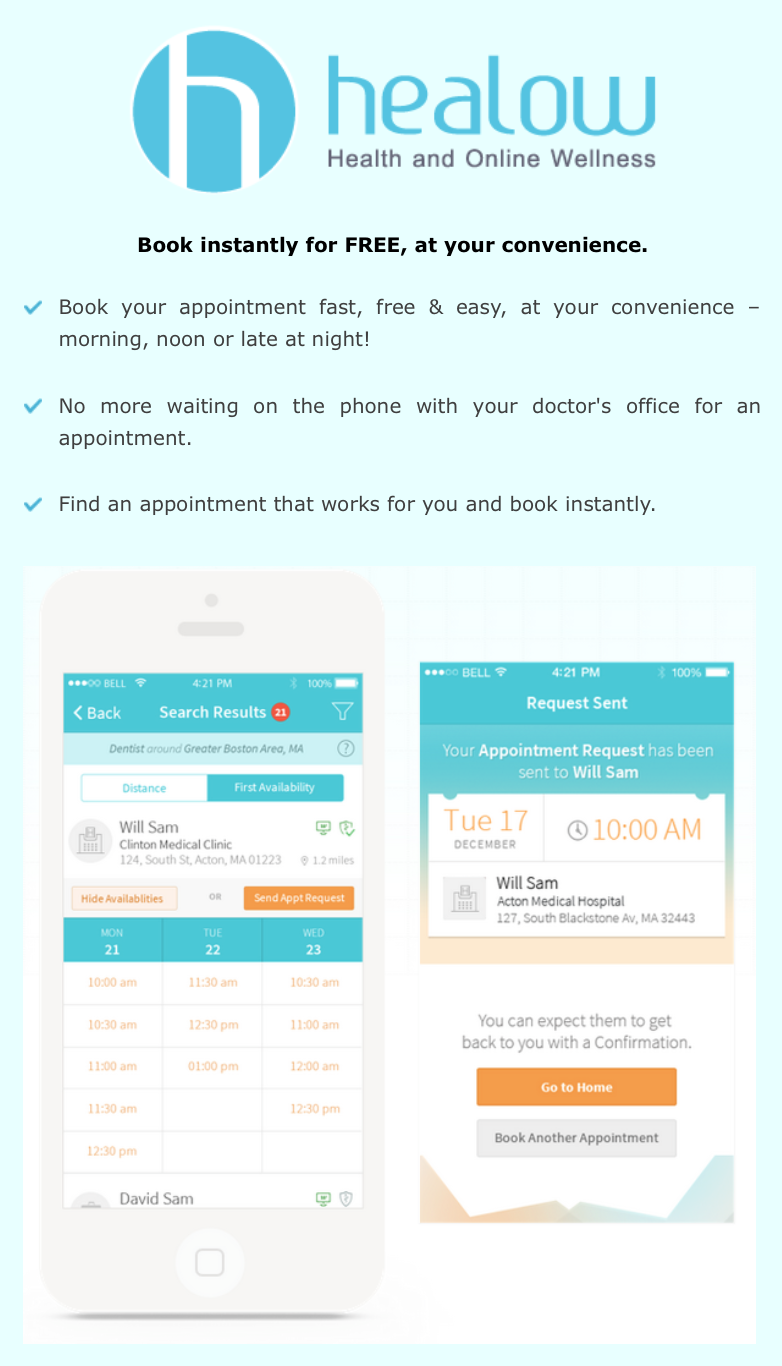
Our biggest goal this year it to make things easier for you.  A few months ago we launched an app called HEALOW, to message us directly, request refills and also make appointments. Your needs met quicker!

Connected to your electronic medical records, the secure HEALOW app is now available in the Apple App Store and Google Play. Here you can download your medical records, directly message our office and request refills directly to the pharmacy - all from your phone or tablet. 

No more waiting on hold; no more phone tag - hello efficiency!
PLEASE REMEMBER to ask for your username and password during your next visit.

Live well,

-- Dr. Dale

Smartphone attachment brings cheap HIV tests to remote areas

“This is fascinating. I love the future.”
— Dr. Dale

http://mashable.com/2015/02/06/hiv-syphilis-smartphone-test/

JESSE EMSPAK for LiveScience

Feb 06, 2015

There are gizmos that let your smartphone read credit cards, sync with your fitness wristband and even function as a TV remote control. Now you can add "run an HIV test" to the list.

A device invented by biomedical engineers at Columbia University turns a smartphone into a lab that can test human blood for the virus that causes AIDS or the bacteria that cause syphilis. The device is a dongle that attaches to the headphone jack, and requires no separate batteries. An app on the phone reads the results.

The dongle contains a lab on a chip. It consists of a one-time-use cassette — which has tiny channels as thin as a human hair — and a pump, which is operated by a mechanical button and draws blood from an inlet through the channels.

Once the blood is inside the device, it meets chemicals that react with markers for HIV and syphilis. This kind of test is called an enzyme-linked immunosorbent assay (ELISA), and is considered one of the best methods for diagnosing diseases, said Samuel Sia, an associate professor of biomedical engineering at Columbia, who led the research.

The blood changes the color and opacity of the chemicals (formally speaking, the solutions' optical depth changes). Then, LED lights shine through the mixture to a set of photocells, which read the change in the color and opacity and send the data to the app. The whole process takes 15 minutes.

The device requires little power because the pump is hand-activated — the person who wants to conduct the blood test presses a plunger to draw the blood. The current to run the LEDs comes from the phone's audio signal, according the researchers' report of their device, which was published on February 4th in the journal Science Translational Medicine.

The test results can be read by anyone with little prior training in lab technique necessary, the researchers said.

The researchers got the idea for the device when examining the costs and the logistical difficulties of getting equipment for HIV testing to rural areas or developing countries. Lab-on-a-chip devices have become more common in the last several years, but few are designed for use by people who don't have a lot of training, and the devices themselves tend to be expensive and customized.

"People [developing such devices] were not focused on usability," Sia said. "If you have a test that takes 20 steps and a laboratory staff, that's not going to make an impact on society."

Although sophisticated lab technology is scant in the developing world, smartphones are being adopted quickly. The research firm Informa UK projects that the number of smartphone connections, a close proxy for users, in Africa will grow to 204 million in 2015, from 154 million in 2014.

That kind of growth makes smartphones a natural target for the kind of technological development involved in the blood-testing device, the researchers said.

Sia said the device should cost about $34. The equipment normally needed to run an ELISA test usually costs $18,000 or more, and the tests themselves — if one screened for both HIV and syphilis — are on the order of $8.50, according to the paper. To keep costs down in the new method, the cassette is made via injection molding, a process that allows for mass production, and each test would run about $1.44.

The device can also work with an iPod, the researchers noted.

The team tested the device at three clinics in Rwanda, with a total of 96 patients, as part of a screening program to help prevent mother-to-child transmission of HIV.

When looking to see whether patients were infected with HIV or syphilis, the test was able to correctly identify an infection 92 to 100 percent of the time.

The testing device was compared to commercial lab tests and produced 12 false positives for HIV. In testing syphilis, of which there are two types (treponemal and nontreponemal), there were 26 false positives in total and only one false negative. Sia noted that false positives are often caught as the patient goes for further treatment and more-sophisticated testing, and for scoring purposes it's generally better to have some false positives and fewer false negatives.

Because there's no need to ship the blood sample to a laboratory, health workers can discuss the results with the patient on the spot. This also removes some of patients' privacy concerns, the researchers said.

The patients also seemed to like a finger prick more than the needle used to draw larger quantities of blood in traditional testing, Sia told Live Science.

The work was funded by a Saving Lives at Birth transition grant and the Wallace H. Coulter Foundation. The team collaborated with a company, OPKO Diagnostics, and two researchers on the team are employees of that company, according to the study.

The paper appears in the Feb. 4 issue of Science Translational Medicine.
7 Things You Should Know About Autoimmune Diseases

“Great article by Sarah Klein of the Huffington Post.”
— Dr. Dale

The Huffington Post  |  By Sarah Klein

http://www.huffingtonpost.com/2015/02/05/what-are-autoimmune-diseases_n_6565164.html?utm_hp_ref=healthy-living

As if living with chronic illness wasn't challenging enough, living with an autoimmune disease can be even more difficult.

Still highly misunderstood by medical professionals and the public alike, autoimmune diseases are characterized by nebulous symptoms that can make diagnoses difficult to come by. Treatments vary, and in some cases rely entirely on behavior changes.

In an effort to making living with -- or loving someone with -- an autoimmune disease just a little bit easier, here are seven important things to know about these health conditions.

1. Autoimmune diseases essentially cause a person's body to fight itself.

We all have an immune system, comprised of the cells and organs that fight off germs and other foreign invaders. In a healthy person, the body immediately understands the difference between cells that are your own and therefore safe and cells that are foreign and need fighting off. In people with an autoimmune disease, the immune system is flawed in a way that causes it to attack normal cells. "The result is a misguided attack on your own body," writes the Office on Women's Health, which can affect any number of the body's functions.

2. There are more than 80 types of autoimmune diseases.

A small sampling of those conditions includes Celiac disease, Crohn's disease, endometriosis, Guillain-Barre syndrome, narcolepsy, psoriasis and rheumatoid arthritis.

3. Autoimmune diseases are relatively common.

The National Institutes of Health estimate that upwards of 23 million Americans are affected by an autoimmune disease. That's roughly about as many people who have been diagnosed with Type 2 diabetes. But the American Autoimmune Related Diseases Association (AARDA) estimates that number may be closer to 50 million. Specific autoimmune diseases, on the other hand, can be extremely rare. For example, types of the autoimmune disease vasculitis may only affect 200,000 people or less, USA Today reported.

4. They can be genetic.

There's evidence to suggest that family members are more likely to develop the same or similar autoimmune diseases. But genes don't paint the whole picture. It's likely that environmental factors and even infections play a role in triggering an autoimmune disease in a person with a genetic predisposition.

5. Autoimmune diseases are not allergies.

Symptoms of autoimmune diseases are sometimes confused for allergic reactions. And while there is some evidence linking a genetic predisposition for both allergies and autoimmune disease, and even suggesting that allergies may trigger autoimmune diseases, the two are different conditions entirely. Celiac disease is a clear example: A person with a wheat allergy and a person with Celiac disease would both be treated similarly; namely, they will both remove gluten from their diets. But the body of a person with a wheat allergy is not attacking itself. That person is not at the same risk of intestinal damage, nutritional deficiencies and other risks associated with Celiac disease, like some types of gastrointestinal cancers.

6. They can take years of trial and error to diagnose.

Because many autoimmune diseases affect various parts of the body across specialties, and symptoms may come and go, these conditions can sometimes be difficult even for medical experts to recognize and consequently treat, according to the AARDA. In most cases, there is no single test a doctor can order to confirm a diagnosis; rather, tests either suggest one diagnosis or rule out others. It's not uncommon for someone with an autoimmune disease to receive another diagnosis first, or to be told that his or her symptoms are just due to stress, Everyday Health reported.

7. Chronic fatigue syndrome and fibromyalgia are not autoimmune diseases.

Both are frequently categorized as such, because they share many common symptoms to autoimmune diseases, but they are technically not autoimmune diseases. As such, fibromyalgia and chronic fatigue syndrome may be even less understood by doctors. People with fibromyalgia and chronic fatigue may, however, also have associated autoimmune diseases, according to the AARDA.

Clarification: This article has been update to distinguish between Type 1 and Type 2 diabetes.